
Reduce inbound support volume with AI voicebots.
Handle high-volume support calls automatically.
AI voicebots handle common customer queries end-to-end, reducing inbound call volume, wait times, and agent overload—without disrupting your existing support workflow.

AI Voicebot for Enterprises
Experience the next evolution of AI Voicebot for Enterprise.
eDAS VoiceBots deliver context-aware, sentiment-driven conversations that strengthen customer relationships and elevate self-service performance.
Fewer calls, faster resolutions, lower costs—powered by enterprise-grade AI.
Unlock the impact of AI Voice.
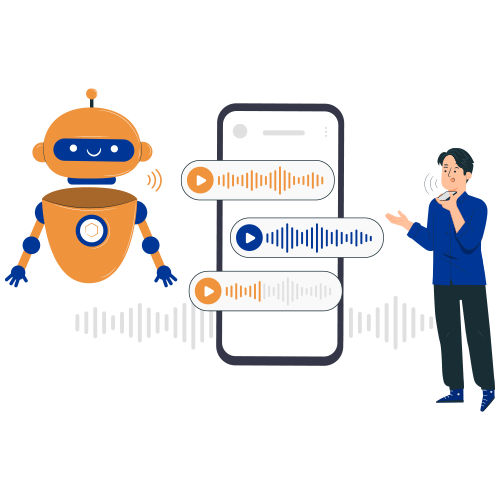
What advantages come with adopting an AI Voicebot for Enterprise?
How can an AI Voice Bot for Enterprise transform your customer experience?
- Resolve customers’ issues quickly through natural conversation
- Improve customer experience by delivering effective responses
- Allow agents to spend time on high-value interactions
- Route the caller to the most appropriate agent
- Hold human-like conversations
- Achieve multiple tasks at once
- Predict customer intents
- Personalized greetings
FAQs on Voicebot
An AI Voicebot is a voice-based system that answers calls and speaks with customers the way a trained agent would—listening, responding, and completing specific tasks.
In real contact centers, Voicebots handle things like checking order status, booking appointments, capturing customer details, or routing calls. When a request goes beyond what the bot is designed to handle, it transfers the call to an agent with the conversation history already passed along.
Unlike older systems, the goal isn’t to block agents—it’s to handle the predictable calls so agents can focus on the ones that actually need human judgment.
Traditional IVRs make callers adapt to the system.
AI Voicebots adapt to the caller.
Instead of forcing “press 1, press 2,” Voicebots let people speak normally and figure out what they want.
The practical differences teams notice:
No fixed menus to design or maintain
Understands what the caller is trying to do, not just keywords
Can handle follow-up questions in the same call
Transfers smoothly when human help is needed
Connects directly to CRMs and internal systems
For high-volume environments, this usually means fewer dropped calls and less frustration for customers.
Most teams adopt Voicebots to remove pressure points, not to replace agents.
Common problems they solve:
Long wait times during peak hours
Repetitive “status check” and “basic info” calls
Missed calls after office hours
Rising cost per call as volumes grow
Agent burnout from low-value conversations
The result is more predictable operations and better use of agent time.
Yes, and this is where many teams see fast impact.
Voicebots are used for:
First-touch lead qualification
Following up on website or form submissions
Appointment confirmations and reminders
Payment and renewal follow-ups
Re-engagement campaigns
They can place thousands of calls at once, filter out low-intent responses, and pass only qualified conversations to agents.
Yes—this is what makes it useful.
Voicebots commonly connect with:
CRMs like Salesforce, Zoho, HubSpot, or custom systems
Dialers and CCaaS platforms
Ticketing tools
Payment gateways
Internal databases and APIs
This allows the bot to fetch information, update records, and trigger actions during the call itself.
Pricing usually depends on how you plan to use it, not a flat license.
Cost factors include:
Call volumes and concurrency
Inbound, outbound, or blended usage
Number of integrations
Language support
Complexity of use cases
Most vendors offer usage-based or monthly pricing so teams can start small and scale.
Results vary by use case, but teams often see:
30–60% of calls handled without agents
Lower average handling time
Reduced staffing pressure during peaks
Faster response times
Improved customer satisfaction
Many teams notice measurable ROI within the first few months.
Most successful teams start small:
Identify the top call drivers
Pick one or two use cases
Run a pilot
Measure containment and CSAT
Expand gradually based on results
👉 Book a demo to see how an AI Voicebot would work in your contact center—not in theory, but in practice.

What Can We Help You With?

